
The Arab horse is easily recognized on its distinctive head shape and high tail carriage. As the name suggests, the Arabian – also known as the Arab horse – come from the Arabian Peninsula. It is one of the oldest extant horse breeds and has been around for several thousand years. The oldest remains of Arabian-looking horses investigated by archaeologists in the Middle East are dated to roughly 4,500 years ago.
The Arab horse developed in the harsh and arid conditions of the Arabian world and many of these horses feature a jibbah – a slight bulge on the forehead that indicates extra sinus space. This enlarged sinus space is believed to help the horse cope with the dry desert environment.
Because of their remarkable speed, endurance and strong bones, the Arab horses have been heavily utilized in the creation or improvement of other horse breeds around the world.
Uses
Arabians are known for speed, endurance and strong bones. They horses dominate the endurance riding discipline, and are also utilized in many other equestrian sports.
The Arabian horse, which is rather light-weight, is not a common choice for jobs suitable for heavy horses, such as ploughing and pulling high-weight loads.
Even though the Arabian is a light-weight horse, it can carry surprisingly heavy riders.
The Arabian horse has long been a status symbol and is a common gift among the rich and noble on the Arabian peninsula. Having high quality Arabian horses show that you are not just a trader that has gotten lucky in the CFD market or stock market. It shows that you are a man of means and importance. A man of importance.
Horse or Pony?
According to the Arabian horse breed standard established by the U.S. Equestrian Federation, an Arabian horse stands between 14.1 and 15.1 hands, with occasional individuals under or over.
14.2 hands is the generally accepted cutoff height between pony and horse, but all Arabians are considered horses – even individuals smaller than 14.2 hands.
Temperament
A typical Arabian horse is alert, sensitive, intelligent and spirited. Just like the thoroughbred and the barb horse, it is known to be “hot blooded”.
Their intelligence is, of course, a double-edged sword for us humans. It makes them easy to train, but they will also quickly figure out how to get what they want.
The Arab horse was developed by desert-living nomads. It was quite common to keep the horse inside the tent rather than outside, to protect it from the environment and from being stolen. Especially mares were likely to live inside. Because of this, the Arab horses – especially the mares – had to be gentle and capable of living in very close proximity to a whole family, including small children. This feature of their temperament is still noticeable today. In the United States, the Equestrian Federation allows children to exhibit Arab stallions in show ring classes – a testament to how safe these horses are. (For most other breeds, children are not allowed to exhibit stallions.)
Physical Characteristics
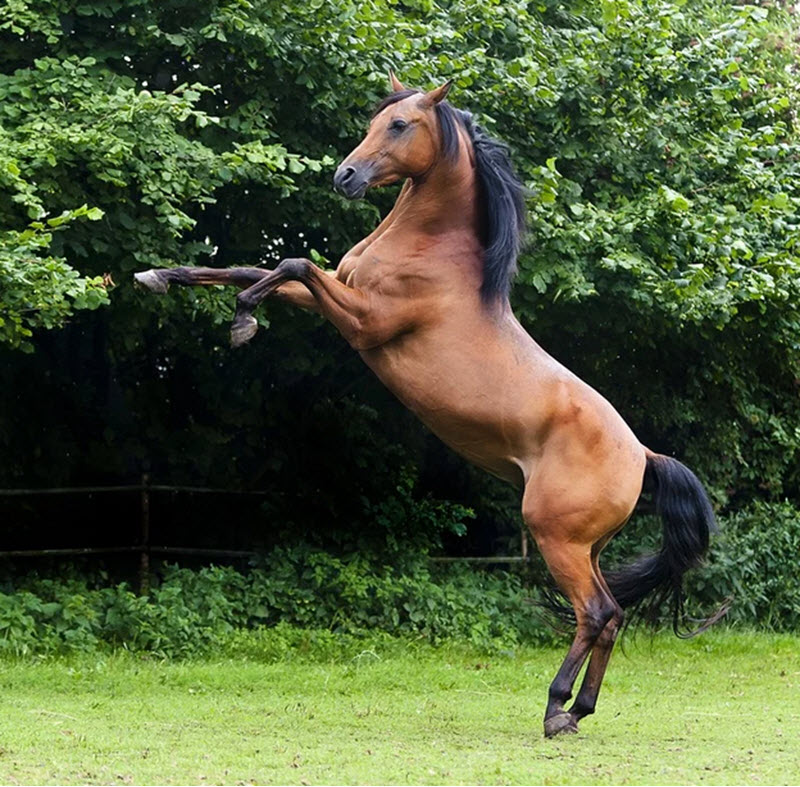
A typical Arabian body will be compact with a short broad back and a level (and fairly long) croup. The shoulder is well laid-back and the hip is both deep and well-angled. The horse carries its tail high.
Head
- The head of an Arabian horse is refined and wedge-shaped, with a broad forehead and small muzzle. Most Arabians have a concave profile.
- The eyes and nostrils are large.
- Many (but not all) Arabians features a jibbah; a slight bulge between the eyes. The jibbah is indicative of the horse having extra sinus capacity, and this is believed to make the horse better suited for a dry desert climate.
Neck & Throat
- Arched neck.
- Large and well-set windpipe.
- Refined and clean throatlatch.
- A long mitbah is highly desirable since it adds flexibility to the brindle and provides lots of room for the windpipe. (Mitbah is the structure of the poll and throatlatch.)
Skeleton
Most Arabians feature dense, strong bones. They are renowned for their excellent hoof walls and sound feet.
The high bone density of the Arabian helps make it strong. These horses might look small and dainty, but looks can definitely be deceiving.
Most Arabians have 5 lumbar vertebrae and 18 pairs of ribs, which is the norm for horses. However, it is not that unusual for Arabs to instead have just 5 lumbar vertebrae and 17 pairs of ribs.
Muscles
There is quite a lot of variation within the breed as far as muscling goes.
- Some Arabs feature especially powerful muscling. They are sought after for reining and other activities that require intense bursts of power rather than endurance.
- Other Arabs come with leaner muscling, typically combined with narrower hindquarters. They are sought after for endurance activities.
History
The Arabian Horse: A Living History
From the arid deserts of the Arabian Peninsula to the foundation of global modern breeds
Archaeological petroglyphs and cave art across the Arabian Peninsula show early hot-blooded proto-Arabian equines with concave dished profiles, large nostrils, and high-set tail carriages adapted to extreme desert climates.
Nomadic Bedouin tribes cultivate the breed through strict matrilineal oral pedigrees. War mares are treasured as family members (often sheltered inside tents), selecting for incredible endurance, speed, intelligence, and loyalty (Al Khamsa traditions).
Following the unification of the Arabian Peninsula, Arabian light warhorses carry Islamic caliphates across North Africa and the Iberian Peninsula, introducing Arabian genetics to Southern Europe and establishing the Andalusian/Iberian foundation.
European knights encounter Arab cavalry and marvel at their agility and speed compared to heavy European destriers. Knights bring Arabian stallions back to European kingdoms, beginning centuries of nobility-sponsored crossbreeding.
Three imported Middle Eastern stallions—The Byerley Turk (1680s), The Darley Arabian (1704), and The Godolphin Arabian (1729)—are bred with native English mares, founding 100% of all modern Thoroughbred racehorse paternal lineages.
Monarchs in Poland, Hungary, Russia, and Germany establish dedicated state studs (such as Janów Podlaski in 1817 and Marbach). Count Alexey Orlov uses Arabians (notably the stallion Smetanka) to create the famous Orlov Trotter.
Wilfrid and Lady Anne Blunt travel directly into the desert to acquire authentic desert-bred Asil mares and stallions, establishing Crabbet Stud in Sussex. “Crabbet lines” become the cornerstone of Arabian breeding programs worldwide.
Hamidie Society of Syria exhibits 45 purebred Arabian horses at the World’s Columbian Exposition in Chicago, captivating the American public and leading to the creation of the Arabian Horse Registry of America in 1908.
The Royal Agricultural Society of Egypt (later the Egyptian Agricultural Organization / El Zahraa) preserves classical Bedouin strains, leading to the globally revered “Straight Egyptian” lineage prized for extreme type and refined head shape.
The World Arabian Horse Organization (WAHO) is established to unify studbook standards globally. Today, the Arabian is celebrated worldwide for halter beauty and completely dominates international FEI 100-mile endurance riding.